Featured

AUTISM CLASSROOM

I just discovered that my county uses a regular curriculum with our autistic students. How stupid to think that this would benefit these children who need an entirely different approach.

These are some ideas that I used when I had autistic children. ALWAYS KEEP IN MIND THAT THE BRAIN LOVES MUSIC, MOVEMENT, CROSSING MIDLINE AND WATER.

Water bottles on every desktop

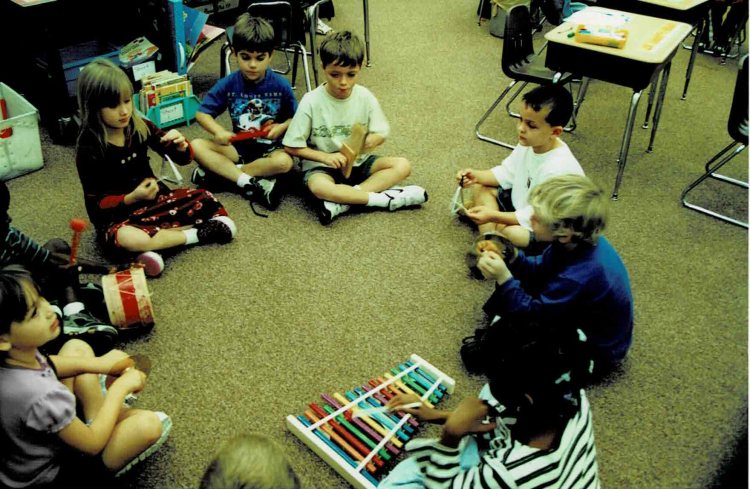
Morning Songs Begin the day with music and movement. Teach all skills using songs while crossing midline.

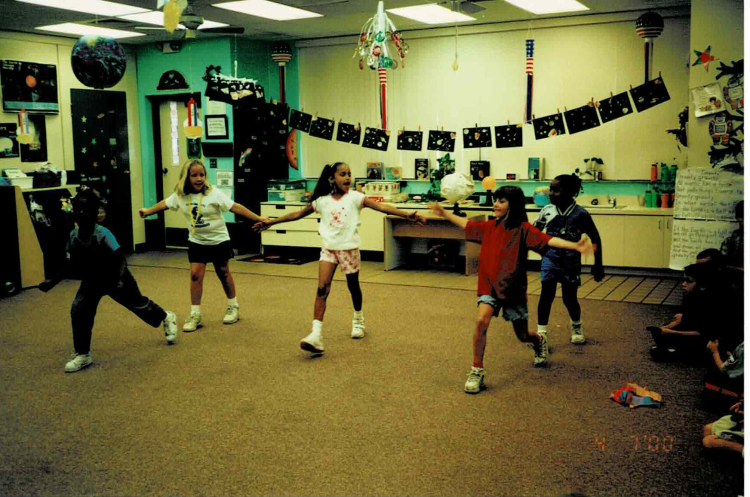
Balloon Ballet Inflate a balloon and have the children move to classical music while keeping the balloon from touching the floor.

Obstacle Course Use balance beam, hula hoops, milk cartons, Cross-foot patterns and crawling tunnel.

Puppet theater Have children decorate a lunch bag to look like themselves. Have them talk to each other in the theater. Purchase animal puppets and let them act out stories like the Three Little Pigs. Autistic children may speak much more when using a puppet.

Crawl to music to build hemispheric transcenion allowing them to access both hemispheres of the brain.

EARLY START PROGRAMS SHOULD BE FILLED WITH MUSIC MOVEMENT AND MAKE-BELIEVE. FUN FUN FUN

AUTISM HOME PROGRAM TESTIMONIAL

This is a note I got from a grandmother who has been using my home program for about two months.

“Last night I walked in on Isaac praying all by himself. I caught him saying ” God, for today thank you for the games we played, thank you for Grandma, and thank you for me, Isaac Amen,”

For a little boy who was almost non-verbal two months ago, this is quite an advancement.

AUTISM HOME PROGRAM

  • Growing up poor on a farm, I spent my childhood doing barn chores and working in the fields and huge gardens. I remember Mom would put us in the neighbor’s strawberry patch, and when we had picked 100 quarts, she would be paid five dollars. I hated being poor, so by age 12, I had three jobs: babysitting, delivering newspapers, and peddling produce. I also knew that I would become a teacher and work with poor kids with learning problems
  • I spent 42 years teaching all grades from kindergarten to middle school as well as special education classes at the college.
  • After retiring, I worked as an inclusion specialist for the college in preschools and as a consultant for a charter school.
  • I have worked with many children since retirement with huge success and gratitude from parents who did not know where to turn.
  • I am currently working with an autistic boy who lives part-time with his grandparents.
  • I gave them many strategies and exercises to help him become more verbal and less stressed. Doing these exercises repeatedly will build confidence and motivation. Children need physical activity away from the “screen”.
  • Here is a list of those strategies:
  • 1. Check his balance. Can he stand on one foot to the count of ten? Can he walk heel/toe for six feet? If not, go on the Web and look for ways to improve it. Balance is a precursor for memory. They are inextricably linked. That is why when we get old and lose our balance, we often lose our memory.
  • 2. Sing everything with him. “This is the way I brush my teeth, brush my teeth, brush my teeth.” “This is the way I take my bath, take my bath, take my bath.” Also, purchase or download songs and let him sing and dance to them. Music transcends both hemispheres of the brain and leads to long-term memory. That is why we adults can remember every childhood song, and why Tony Bennett could sing every one of his songs, even with Alzheimer’s.
  • 3. Have him crawl to music. It must be bilateral, right foot, left hand, and left foot, right hand. This will build the corpus callosum which connects the two hemispheres of the brain.
  • 4. Practice crossing midline. Look on the Web for ways to increase crossing midline.
  • 5. Check his proprioception by asking him to close his eyes and bring his index fingers together in front of his face. Ask him to close his eyes and bring his index fingers to touch his nose. Ask him to close his eyes and touch his head, toes, shoulder, etc. Again, look on the Web to find ways to improve it. This is an important area and an inability to do this may lead to meltdowns because he is not aware of where his body parts are and what they are doing. Very frustrating!!
  • 6. Make a puppet from a lunch bag or sock that looks like him. Decorate it with yarn, buttons and marker. Make one that looks like you and use them to talk back and forth. You may be able to buy one on the Web. This will be fun and encourage language.
  • 7. If your child attends Occupational Therapy, ask the therapist if you can attend a session. Write down everything she does and do that activity every day. Motor and neurological lags will improve more quickly when done every day and not just once or twice a week.
  • 8. Have his eyes checked by a specialist. Check for dominant eye, binocular coordination, convergence and tracking. Poor vision can affect the way he behaves and also learns.
  • 9. When he does something really good, try this for an ego booster: “I’m good (put right hand on left shoulder). I’m very good (put left hand on right shoulder). And I can do good things.” (Give himself a great big hug)!!
  • Certainly, every child is different, and these activities may not help your child. However, try some of them and it may give you HOPE for improving your dear child’s life.

Here are comments from a grandmother who has been using MyPearl Home Program:

“I just want to share how delighted I am with the progress I have seen in my 6-year-old grandson since we began using some of the suggestions made by Susan in her PEARL program.

In just two week’s time of working on exercises to cross the midline, we have seen improvement in communication with new sentences popping out regularly now. In the past, most communication was “scripting” or memorized but now my grandson is pretending while at play and his toys are having conversations. He is also more able to ask for things he needs or wants now. I’m especially pleased to see that he is making much more eye contact both when we are speaking to him and when he is speaking to us.

I am so glad to be able to know these simple exercises and incorporate them into our daily schedule. When the exercises can be a fun activity, there is no difficulty in helping a child to do them.

I’m so grateful that Susan has been advising us and shared access to her videos and blog so we could immediately begin using the program she developed to help our grandson increase his communication skills.”

Every Day

Every day after I read my newspapers, I always search the county arrest reports to see how many of my sweet children have been arrested. Most of them are drug-related, but I also have two that are up for murder. Many of these kids were not academically talented but were just as smart as the other kids who fortunately had the right wiring of the brain to be successful.

I.Q. has so little to do with success in school today. It is a case of the right wiring and learning styles. The child who is right-handed, right-eyed visual has the greatest chance of academic success because he is able to sit and fill in mindless worksheets because that is how he learns. However, the child who is kinesthetic/tactile mixed dominant suffers in these purely visual classrooms. He needs to move and touch to learn. He is likely to be labeled ADHD because of his boredom and frustration. he will be labeled as a trouble maker, rude, insolent and incorrigible because his needs are not being met. The one common factor that the majority of these kids who are arrested share is that they are UNEMPLOYED. No kidding. We do not know how to teach them but we use the same approach year after year, and when they can stand it no more, they drop out as soon as they can. They go out on the streets and find out that making 500 dollars a day selling drugs is far superior than flipping hamburgers for ten dollars an hour.

What we could have done is give them an aptitude test in 9th grade and allow them to pursue a trade/tech area when they can graduate CERTIFIED in a trade/tech area and begin earning money the first day after graduation.

We would rather let them sit in Algebra and Remedial Reading for hours a day with no hope of passing the courses. Then we allow them to be sent to prison and after spending ten to twelve years in prison, the government has the nerve to say we have a federal program to train you for a job. IT IS IMMORAL AND STUPID TO KEEP DOING THIS. God help us out of this quagmire and use common sense to improve the lives of so many.

Since retiring from my A district, 32 of my former pupils have gone to prison and 7 have been murdered or killed. My heart aches for futures that were never lived and dreams that were never fulfilled. GOD FORGIVE US.

_____

We have the lowest ACT scores ever! Everything I have said for 43 years has come true. I go to Sarasota County offices for advice on changing education, and they look at me as if I am crazy. I contact the early learning coalitions and offer to demonstrate my screening for children with deficits, and they will not even meet with me. They tell me they have specialists who know what to do with our early learners. Even though I was called the BRAIN LADY at Oxford University, they ignore me. This is what I would do to improve education. Too often, the rich get educated, and the poor get incarcerated.

  1. Eliminate the Department of Education in Washington and use their budget to build trade schools.
  2. Add another year at the beginning of school for kids who come to school not ready to learn. Have a PRE K, K, PRE FIRST AND A FIRST. Give them more time to get ready for learning. You would reduce the number of children who fail first grade. Failing first grade is not a great way to start school.
  3. Stop making Algebra a requirement for graduation. Replace it with basic math courses so maybe our cashiers can make change from a five dollar bill. It is so ridiculous to fail so many students because they cannot pass a worthless subject.
  4. Give an aptitude test to every failing month-grade student regardless of GPA. Allow them to graduate CERTIFIED in a trade so they can start work the day after they graduate. Stop having so many kids move right from the school system to the prison system. The question remains WILL WE BUILD BETTER SCHOOLS OR BIGGER PRISONS?

_____

America’s public schools are failing too many kids. Many kids enter kindergarten with a mental age of 3 or 4. They are thrown right into a curriculum made for a 6 year old. Kindergarten is the new first grade.

When we had balance beams, balls, puppet theaters, music, games and centers in kindergarten, we were #1 in the world. Now that we have computers, worksheets and books in kindergarten, we score at the bottom or near the bottom on international assessments.

Too many kids fail first grade because they are just not ready for reading. That sense of being a failure may stay with them for the rest of their lives. I propose that we add another year at the beginning of school for those who need TIME. You would have PRE K, K, PRE FIRST AND FIRST. It would be and extra year just for those who need it. Fewer kids would fail first grade and they could learn to love school. Public schools do not just need more dollars and cents, they need more common sense.

_____

I tested children last month at a Children’s Expo. They were ages 5-9. They had poor balance, could not cross midline, catch a ball or throw bean bags into a crate. I was shocked by their lack of basic motor skills. All these skills affect reading.

Our early start programs are so concerned with literacy and ignore these basics that must be addressed early.

Remember when we were number 1 in the world in education and every kindergarten had balance beams and balls? Now we are at or near the bottom on international assessments, and we continue to push literacy in our youngest children. 66% of 8th graders cannot read on grade level. Yet we continue to stay the course with devastating results.

______

Can you imagine sitting in a nuclear physics class for 4 years and not knowing a thing about nuclear physics?? Failing every test and being bullied by teachers and peers for being an idiot?

That is how too many kids are in high school today. Growing angrier and more bitter every day, hating everyone in their world.

For God’s sake, stop this insanity and let them take tech/trade courses in 9th grade so they can succeed at something for the first time in their school career.

We must change or continue to breed lost souls without hope.

_____

I am so distressed because I had to withdraw my 2000 dollar scholarship for a student at our vocational school. I made it quite clear that it had to be a student from our local high school who was pursuing a career in auto mechanics. GUESS WHAT?? They did not have one student who met the qualifications. Of our 2200 students in our local high school who wanted to be an auto mechanic?? Yet as I travel around town, I see kids everywhere working on skateboards, bikes and cars. One of the problems is that they must have a 2.0 grade average to enroll in the tech center. What happens to the kids who do not reach that??

_____

OPEN THAT SHELL

MY PEARL PROGRAM IS DESIGNED TO OPEN THE SHELL THAT OFTEN IMPRISONS OUR DEAR CHILDREN. WITH LOVING PARENTS, CARING TEACHERS AND BRAVE PRINCIPALS, WE CAN OPEN THAT SHELL TO REVEAL THAT BEAUTIFUL PEARL WITHIN.

SPARK THAT BRAIN!!!!! THE BRAIN LOVES MUSIC, MOVEMENT AND WATER.

SING IT, AND THEY WILL LEARN IT!!

IF CHILDREN DO NOT LEARN THE WAY WE TEACH THEM, THEN WE MUST TEACH THEM THE WAY THEY LEARN.

READY OR NOT??

50% of Tampa Bay kids are not ready for kindergarten but they will probably start in a curriculum written for a seven-year-old. Kindergarten is the new first grade. having tested hundreds of children in my 41 years of teaching, I know that many start school with a mental age of three or four. They are put into a curriculum two or three years above their mental age. By the time they are truly ready to read, they already view themselves as failures. SO SAD!

No balance beams, blocks, centers or puppets, just computers, tablets and worksheets.

I truly believe we should add another year at the beginning of school for kids not ready for academics. You would have PRE-K, K, PRE-FIRST and then FIRST. It would be a naturalprogression and not allow so many children to fail kindergarten or first grade. Failing a grade is not the best way to start school. It is a stigma that may follow them the rest of their lives.

_____

Did you sit with your back to the board in school? Today, teachers have children sitting in crazy configurations which are so harmful to their visual-motor skills.

One night at college, I put all the chairs so they were at an angle or with their backs to me. Within 10 minutes, they were complaining that they could not stand it. All instruction should be eyes forward with no turning of the eyes. Also, allow kids to choose their own seats and they will sit where their learning style and dominance profile are best suited. We are increasing learning problems by these poor practices.

______

I am amazed with all the mass shootings, no one ever discusses the failure of public schools to meet the needs of struggling students.

Here are some major failures: Expecting all kindergartners to read and then failing them if they cannot. Using visual/lecture methods solely, making kids take algebra even if they cannot add or subtract, keeping 13-year-olds in remedial reading instead of taking tech/trade classes, having little discipline, allowing students to be bullied for years without serious intervention by school officials, allowing poor teachers to remain for years and high-stakes testing. We need major changes NOW!

_____

I am working with an autistic child. In two weeks of doing my plan, he has gone from one word only to complete sentences. What is more important, they are relevant and not just gibberish.

This is my plan: Sing everything from brushing teeth to taking a bath. Have him crawl to music, bilaterally. Practice crossing midline. Look on the web. Check his balance and work on it. Can he stand on one foot to the count of 10? Check his proprioception. Can he touch his index fingers together in front of his face with eyes closed? Check the web for exercises to improve these skills.

_____

As another school year begins, just a word about those squirmy little ones who cannot sit still. Place them in the back of the room. Glue velcro inside their desk for them to rub. Allow them a squeeze ball or a ball of clay to manipulate. Put a bungee cord across the bottom of the legs of the desk for them to move their feet. Allow them to stand up to do their work. NEVER TAKE AWAY RECESS FOR PUNISHMENT. IF THEY COULD SIT STILL, THEY WOULD SIT STILL.

_____

Some hints for new teachers on setting up your classroom. Make sure all desks are facing the front of the classroom with no turning of the eyes to see. This can cause visual-motor problems. Allow the kids to choose their own desks. They will choose the right one for their learning style and dominance profile. Use music and movement to increase learning. Music crosses both hemispheres of the brain for long-term memory. Have water bottles on their desks for proper hydration. 83% of the brain is composed of water. The brain loves music, movement and water. Start every day with music and movement to raise serotonin levels and release pent-up energy.

Best of luck for a great school year!

_____

Now that school is out, it is the perfect time to work on your child’s motor and neurological lags. Look on the Internet for proprioception, balance and crossing midline. These are areas that may hamper your child. They will have activities to improve each of these. They all affect a child’s development.

Have your child (age 5 or older) stand on one foot for ten seconds. If he cannot, look up ways to improve balance. Guild a balance beam and have him practice daily. Balance is the precursor of memory. That is why when we get older and lose our balance, we may lose our memory. They are inextricably linked. Inflate a balloon, play classical music and have him try to keep the balloon in the air as he moves to the music. My first graders loved this activity, and it will improve balance, eye-hand coordination and visual-motor integration.

For autistic children, it is so important to practice these areas. I believe they may be the cause of many meltdowns. Build an obstacle course for your child. Again, there are many ideas for doing this on the Internet.

Make sure your toddler is crawling. It must be bilateral (right foot, left hand). Crawling is the first step in building the corpus callosum which connects the two hemispheres of the brain. Music transcends both hemispheres of the brain.

For older children, go to the library and check out books with CDs. Have your child point to every word as it is read. Later, have him read it without the CD. All of these suggestions may help your child make the most of his summer. Happy Summer!

_____

If we are to save the public school system, we must change. First of all, I would eliminate the Dept. of Education in Washington. When it was created, we were number 1 in the world, now we are at the bottom or near the bottom. A boy on a ranch in Montana does not need the same curriculum as a boy in a ghetto in Chicago. I would use their budget to build trade/tech schools across this country.

Next, I would add another year at the beginning of school. You would have a PRE-K, K, PRE-FIRST and a FIRST for children not ready for academics. The first two years would be spent on music, movement and make-believe. FUN FUN FUN1 Many children today come to school with a mental age of three or four. We throw them right into a curriculum made for a six-year-old. By the time they are ready to read, they have given up and view themselves as stupid. By adding a year, you could reduce the number of kids who fail first grade. Failing first grade is not a great way to start school and may haunt them the rest of their lives.

Thirdly, I would eliminate the requirement of Algebra for all students not going to college. Give them the basic math that they might have a chance of passing and might actually be useful.

Last, I would give an aptitude test to all failing students in 9th grade and allow them to start trade/tech classes if they wish. If we allow them to drop out, once they get out on the streets and find they can make a hundred bucks a night selling drugs, we have lost them.

It is often a case of the school failing the child rather than the child failing the school. The question I ended every one of my workshops with is, “WILL WE BUILD BETTER SCHOOLS OR BIGGER PRISONS?”.

_____

I truly believe the vast majority of reading problems are caused by visual deficits. I am amazed that teachers do not study kids’ eyes when they begin to teach reading. It is quite simple: You cannot read if you cannot see”. When I was in fifth grade, I memorized the Snellen eye chart 20/20 line and read it correctly for years. I have little faith in the eye screenings done at school. If your child squirms in his chair, eyes water, squints his eyes when reading or yawns while reading, you may want to have his eyes examined.

You may want a pediatric ophthalmologist who specializes in this. These are the areas that need checked: convergence, tracking, binocular coordination, dominant eye (left eye dominant may cause problems), and acuity.

Do not wait until your child is in fifth grade to have this done, rather do it as soon as your child’s teacher says he is struggling to read. The sooner, the better.

Tips for Raising a Good Student

  1. Limit screen time. NO screen time before age two. Ages three to five, only two hours a day.
  2. Make sure your toddler crawls. It must be bilateral: right foot, left hand, left foot, right hand. This is the first step to building the corpus callosum which is critical for hemispheric transcension..
  3. 80% of the brain is developed by age three. Sing to, read to, coo and caress your infant. This will develop gray matter in the brain for future success.
  4. By age four, check your child’s balance. Can he stand on one foot to the count of ten? Can he walk heel/toe six feet? Balance is a memory precursor. Memory and balance are inextricably linked. That is why when we are old and lose our balance, we often lose our memory. Build a balance beam and have him practice daily. Look on the Internet to find ways of improving balance. It is a CRITICAL SKILL.
  5. Make sure your child stays hydrated. 73% of the brain is water and needs hydration to function properly.
  6. Restrict food dyes and sugary foods. They are horrible for ADHD children.
  7. By age five, ask your child to raise his right hand. If he does not respond immediately, put a red dot on his right hand every morning and all throughout the day, say “RED, RIGHT.”
  8. Have your child throw and catch a ball. For toddlers, roll a ball to him on the floor. This will build convergence of the eyes which is critical for reading. When you go for an eye exam, make sure the doctor checks for convergence. Only five per cent of children have convergence deficiency, but it will cause reading problems.
  9. Read to your child daily and ask questions about the story. Make puppets and act out the story to build comprehension skills. When you are finished reading the story, have him draw a picture of what happened in the story.

These are some ideas for helping your child develop skills not often mentioned but are important for success.

School Should Be Fun For Everyone!!!

Twenty years ago, I wrote a book entitled PEARL. The idea of the book was that children often come to school enclosed in a shell. With caring teachers, supportive parents and proper methods, we can open that shell to expose the beautiful PEARL within.

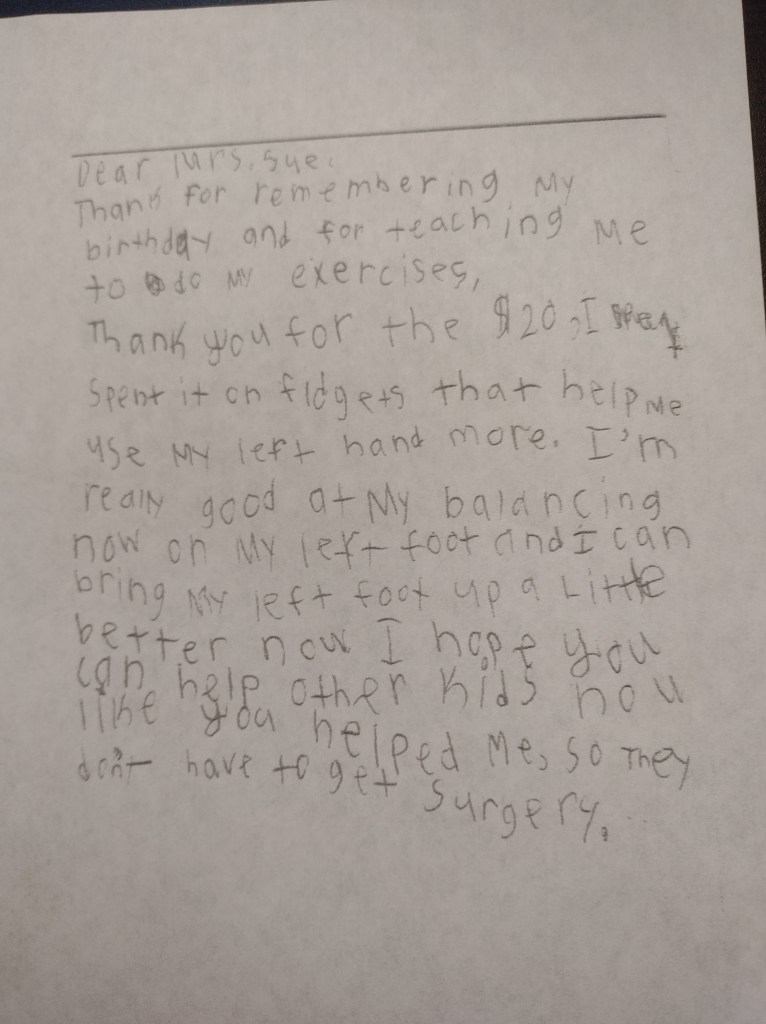
This is the note I received from a six-year-old girl with cerebral palsy. I tested her using the screening and prescribed a home program including balance, core strength and muscle enhancement. She is now riding a bike and has improved in all her abilities to move.